


Air Barriers & Airtightness Membranes
Controlling Air Leakage Through the Building Fabric
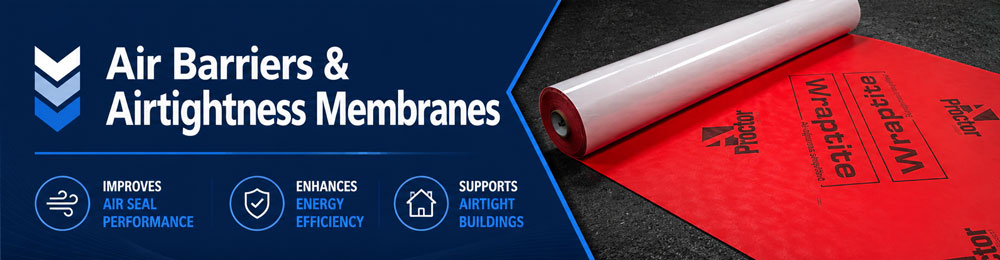
An air barrier, or airtightness membrane, is a continuous layer within a wall, roof, or floor build-up designed to stop uncontrolled air movement through the building fabric. Unlike insulation, which slows heat transfer, an air barrier physically blocks draughts and air leakage paths, which matters because even well-insulated buildings lose significant heat through gaps, joints, and penetrations if the airtightness layer isn't continuous. Getting this right affects energy efficiency, air test results, and long-term comfort, particularly on projects targeting Part L compliance or Passivhaus-level performance.
Where Air Barrier Membranes Are Used
Airtightness membranes are specified across most modern construction types where controlled ventilation and energy performance matter:
-
Timber frame and SIPs construction
-
New build housing targeting Part L or Future Homes Standard compliance
-
Retrofit and deep energy renovation projects
-
Roof and loft airtightness upgrades
-
Steel frame and modular building envelopes
-
Passivhaus and low-energy building projects
The membrane needs to form a genuinely continuous layer around the whole building envelope, since air leakage tends to concentrate at junctions, service penetrations, and joints rather than through the main membrane area itself.
What Makes an Effective Airtightness System
An air barrier is only as good as its weakest joint. The membrane itself is usually the easy part; the detailing at window reveals, service penetrations, roof-to-wall junctions, and floor-to-wall junctions is where most airtightness failures actually happen during pressure testing.
Worth checking before specifying:
-
Air permeability performance of the membrane itself
-
Compatibility with airtightness tapes and grommets at penetrations
-
Whether the membrane also needs to manage vapour control, or is a separate layer
-
Puncture and tear resistance during installation and follow-on trades
-
Fire classification if required for the specific building type
Getting Through an Air Test First Time
Most air test failures trace back to poor detailing rather than a faulty membrane, gaps around loft hatches, service penetrations, or skirting boards being common culprits. Sealing every junction as work progresses, rather than trying to fix issues after first fix trades have finished, makes a first-time pass far more likely.
Frequently Asked Questions
- What's the difference between an air barrier and a vapour control layer?
An air barrier primarily stops air movement through the building fabric, while a vapour control layer specifically manages moisture vapour diffusion. In practice, many products perform both functions, though not always to the same standard. - Why did my building fail its air pressure test?
Failures usually come from poorly sealed junctions and penetrations rather than the membrane itself, commonly around loft hatches, service entries, and floor-to-wall junctions. - Is an airtightness membrane the same as a breather membrane?
No. A breather membrane sits on the external side and allows vapour to escape, while an airtightness membrane forms part of the internal air control layer. Some buildings use both as separate, complementary layers.