


Damp Proof Course (DPC)
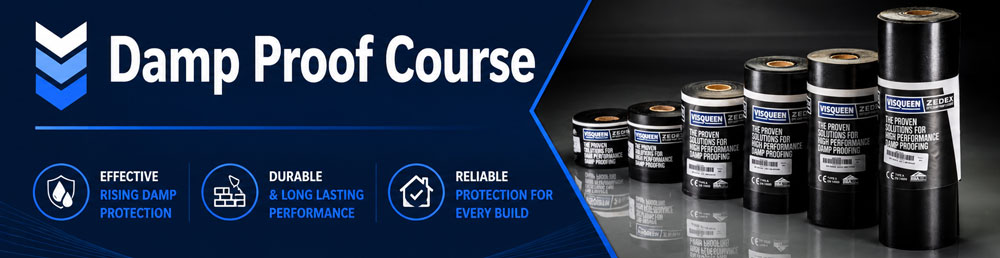
Damp Proof Course DPC Rolls to Prevent Rising Damp
The abbreviation of Damp Proof Course is DPC. This is a roll of Polyethylene. In simpler words the damp proof course is used to stop dampness in buildings. Passing through foundation it rises to reach the walls. To avoid water from rising, lay a Damp proof course layer at the joint level of walls and foundations.
Stopping Rising Damp Before It Starts
Damp proof course, commonly shortened to DPC, is a continuous horizontal barrier built into a wall to stop moisture rising up from the ground through capillary action, a problem known as rising damp. Fitted near ground level, typically 150mm above external ground level, it forms an unbroken layer that groundwater simply can't cross. It's one of the most basic pieces of building fabric, and one of the easiest to get wrong if it's bridged, damaged, or installed at the wrong height.
Where Damp Proof Course Is Used
DPC is a standard requirement in most masonry construction:
-
New build brick and blockwork walls
-
Cavity wall construction, in both inner and outer leaves
-
Retrofit installation in older solid walls without existing DPC
-
Around door thresholds and low-level openings
-
Chimney and parapet wall detailing
-
Below damp proof membrane junctions at floor level
Cavity walls need DPC in both leaves, tied in correctly at the cavity, since a gap or misalignment between the two creates a bridge for moisture to cross regardless of how good the material itself is.
Choosing the Right DPC Material
DPC comes in several materials, and the right choice depends on the wall type and how the DPC needs to perform structurally as well as against moisture.
-
Polythene DPC, the most common and cost-effective option for standard masonry walls
-
Bitumen felt DPC, more traditional, still used in refurbishment work
-
Pitch polymer DPC, offering good flexibility and resistance to damage during construction
-
Engineering brick DPC, used where the DPC also needs to bear structural load
Worth checking before ordering:
-
Compliance with BS 8215 for DPC installation
-
Compatibility with the wall type and construction method
-
Width relative to wall thickness, to avoid gaps or excessive overhang
-
Whether the DPC needs to tie into a damp proof membrane at floor level
Common Causes of DPC Failure
Rising damp complaints often trace back to something bridging the DPC rather than the DPC itself failing. Render applied too low, external ground levels raised above the DPC line, or path and patio surfaces built up against the wall are all common culprits, effectively giving moisture a route to bypass the barrier entirely.
Frequently Asked Questions
- What height should a damp proof course be installed at?
DPC should sit at least 150mm above external ground level to prevent rain splash and ground moisture from bridging it, as set out in current building regulations guidance. - Can a damp proof course fail even if it's fitted correctly?
The material itself rarely fails, but external factors like raised ground levels, render bridging, or damaged sections during later building work commonly cause rising damp even where DPC was installed correctly. - Do older properties without a damp proof course need one retrofitted?
Many older solid wall properties were built without a DPC and can be retrofitted with a chemical injection or physical DPC system, though the right approach depends on the wall construction and cause of damp.